Tech specs
exocortex. $5,000 + tax, free US shipping. Pre-order with a fully refundable $250 deposit; we expect the first 100 to ship by December 2027.
- Price
- $5,000 plus taxFree shipping in the US; elsewhere, shipping and import duties are shown at checkout. Pre-order now. The first 100 ship in December 2027.
- Sensing
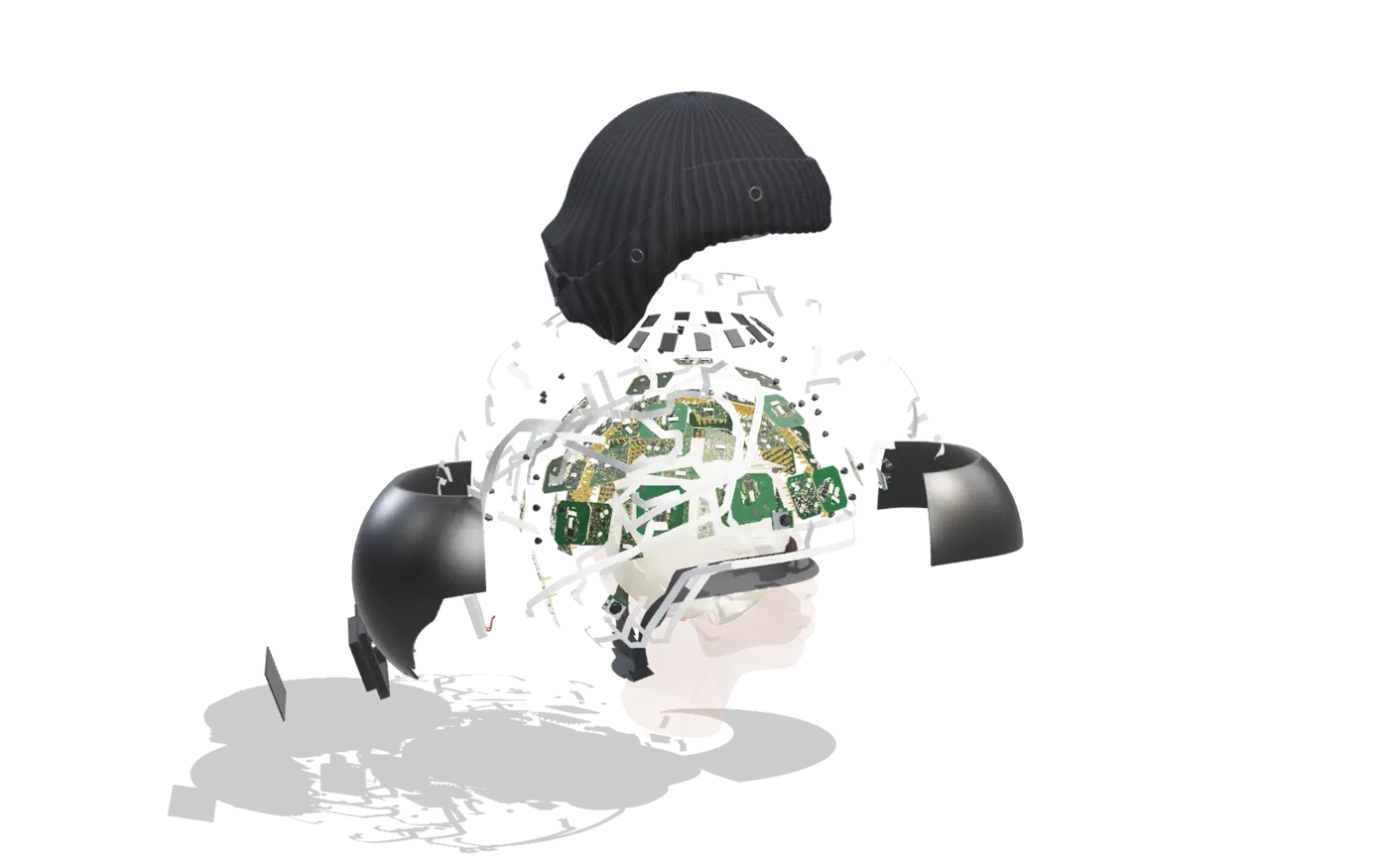
- 1,118 dry contacts, one channel each71.7% of the scalp under a tile; 66 tiles of 9 designs, in three rings and a top
- Contacts
- Kinghelm KH-205580-DZ body, an 8.0 mm gold-plated SMD pogo pin with a rounded plunger and about 2.0 mm of travel, placed by JLC like any other partThe pin to ship is the soft pin, EXO-PIN-S: the same body with a custom spring wound longer than its pocket, so every pin presses with 8.5–11.8 g whatever its gap, 113 N on the head in all instead of 432 N with today's spring. Its spec and request for quotes are written; no maker has quoted it yet.
- Front end
- A TLV333 zero-drift amplifier per contact, gain 101 against the AC-coupled reference contactTLV333 55 nV/√Hz with no 1/f corner; one 12-bit step is 8 µV at the contact, oversampled to 500 SPS
- Converters
- 128 × WCH CH32V203G6U6, 12-bit, up to ten contacts each500 samples per second per channel; one 2.048 MHz clock and one SYNC line to every converter, re-buffered tile to tile; 24 ns skew budget across the head
- Chains
- 16 chains of 3 to 5 tilesTiles daisy-chained three to five to a hub port on one 12-way flat cable: power, reference, clock, sync and a UART ring
- Reference
- REF (eight pins in parallel) and BIAS pogo pins (the same part) on the hub's scalp face (driven-right-leg bias at 1.65 V); a JST-SH jack takes mastoid or ear-clip electrodes instead
- Cameras
- Five: three across the front, two on the back rimOV2640, 2 MP, 160° wide-angle; MJPEG at SVGA (800 × 600), 15 frames a second, up to 25 over its cable
- Audio
- A PDM MEMS microphone beside each camera, 16 kHz, 16-bit
- Privacy
- A red LED on each camera board, lit by the firmware whenever the sensor is powered, with no setting to turn it off. The lens's clear silicone grommet carries its light out through the knit, so a ring round the lens glows while that camera can record. How bright the ring is has not been measured
- Processors
- Two RP2350B at 144 MHz; an ESP32-S3 for Wi-Fi and system controlTwo CH32V203 RISC-V microcontrollers on every tile (one on the small TA tiles); an RP2350A on each camera
- Connectivity
- 2.4 GHz Wi-Fi from the hub's ESP32-S3, the helmet's one radio; the cameras send over their cables and have no radio. All camera video goes over USB, a reduced set over Wi-FiUSB-C, USB 2.0 High Speed (480 Mb/s) through an FTDI FT2232H
- Radio
- One transmitter: the hub's ESP32-S3-MINI-1U, capped at 13 dBm, its flex antenna in the pod ceiling 22 mm from the scalpThe cameras have no radio; their video and sound go to the hub over their cables
- Battery
- 1S lithium-ion pouch, at least 2,500 mAh at 3.7 V, under the pod cover; a certified cell with its own protection circuit, tested to IEC 62133-2 and UN 38.3. The cell is specified; its maker is not chosen yetAbout 1.2 hours with all five cameras streaming (6.94 W), 2 hours with them off; about 2 hours to charge
- Charging
- USB-C through an eyelet in the back of the cuff, 1.5 A (BQ25895). The contacts' supply is held off while a cable is plugged in: it charges only off the head
- Electrical safety
- Every contact sits behind at least 200 kΩ, which limits the current through any one contact if a part fails to 18 µA at a tile's front end (the port's 3.6 V through a shorted LDO), 33 µA at the hub's reference contact (one of its two 100 kΩ shorted) (design values; not yet tested)Leakage current benchmarked against the limits of IEC 60601-1 (a medical standard, used here only as a reference). Not tested or certified.
- Shell
- PETG, five printed parts and the headband2.8 mm wall530 g of PETG to print the six parts (CuraEngine's slice, supports included); 349 g in the solid model
- Headband
- EXO-145: a 1.6 mm PETG band on a 3 mm foam pad inside the shell, round the brow and under the back of the head, closed by a micro-ratchet at the napeIt holds the shell down against the pins: designed for 150 N of pins, 31 N of tension and at most 44 kPa at the brow
- Beanie
- Acrylic 2×2 rib knit with a turned-up cuffLenses through clear silicone grommets that carry each camera's recording light; USB-C through a moulded eyelet
- Certification
- None yet: exocortex is not authorized by the FCCThe plan: FCC Part 15 Subpart B for the electronics, our own FCC ID for the one 2.4 GHz transmitter, the RF exposure exemption, and the battery's IEC 62133-2 and UN 38.3 reports, before the first unit ships
- Open hardware
- The Gerbers, BOM and placement file of every board, every part, and the shell's STL and STEP files are on this siteThe design's source repository is not public yetBill of materials · Plans and files · Design notes
Specifications are design values. exocortex has not been built or measured yet: impedance, noise, motion, comfort and EMC are unmeasured. exocortex is not a medical device and is not for diagnosing, treating or monitoring any condition.